Aluminum Pool Enclosure in Bradenton: Materials, Wind Codes & Installation Guide
If you're considering an aluminum pool enclosure in Bradenton, you're making a smart move for Florida's climate. But here's what separates a 20-year investment from a corroded eyesore in five years: understanding how salt air, humidity, and wind load codes dictate every material choice. This guide walks you through the exact specifications, installation process, and compliance steps that Bradenton homeowners, HOA members, and property managers need to know—so you can make a decision that protects both your pool and your wallet.
The Questions Every Bradenton Homeowner Asks Before Building
- Why does coastal Bradenton require different aluminum finishes than inland Florida?
- What wind load rating do you actually need, and how does it affect your enclosure design?
- How many steps is the permitting and installation process, and what delays should you plan for?
Key Findings
- Aluminum is Florida's standard material due to rust and rot resistance, but Bradenton's salt air demands specialized finishes like PVDF coatings or architectural-grade anodizing to prevent accelerated corrosion.
- Florida Building Code mandates upgraded screen enclosures withstand 160+ mph wind loads in designated zones—compliance is non-negotiable for safety and resale value.
- Installation involves seven distinct phases: assessment, design, permitting, foundation prep, frame assembly, screening, and final inspection. Permitting alone can take 2–4 weeks in Manatee County.
- Manatee County setback rules (5 feet minimum from side and rear property lines) eliminate costly redesigns if you verify before design, not after.
Methodology
This guide synthesizes Florida Building Code requirements specific to Manatee County, Bradenton's coastal salt-air environment, and real-world installation workflows from pool enclosure specialists serving the region. Data on wind load standards, setback regulations, and cost ranges come directly from Manatee County building code documentation and regional contractor research. Material recommendations reflect the physics of saltwater corrosion and humidity in Florida's subtropical climate, not generic advice. Screen options and permitting timelines are grounded in actual project schedules and local compliance practices.
1. Why Aluminum Pool Enclosure in Bradenton Demands Coastal-Grade Materials
Aluminum earned its place as Florida's default enclosure material because it doesn't rust like steel and doesn't rot like wood. That's the easy part. The harder part—the part most homeowners never hear from a salesperson in a hurry to close a deal—is that "aluminum" isn't a single product. It's a base metal that behaves very differently depending on what's coating it, and Bradenton's proximity to Tampa Bay and the Gulf means salt-laden air is constantly working to break that coating down.
Inland Florida homes deal with humidity, but coastal Bradenton properties deal with humidity plus airborne salt particles that settle into every joint, screw hole, and seam. Standard mill-finish aluminum starts oxidizing within two to three years under those conditions. You'll see it first as a white, chalky bloom on the frame, then as pitting where the metal itself starts to degrade. It's not catastrophic on day one, but it compounds—and by year eight or ten, you're looking at a frame that needs full replacement rather than a simple refinish.
This is where finish selection becomes the actual decision, not the aluminum itself. PVDF (polyvinylidene fluoride) coating is the industry standard for direct coastal exposure because it forms a genuine chemical barrier against salt spray, not just a cosmetic layer. When specified at 0.7 to 1.0 mil thickness, PVDF-coated aluminum routinely lasts 15 to 20+ years in Bradenton's environment—roughly double what unprotected aluminum survives. Architectural-grade anodizing (Type II or Type III) is the mid-tier option: it seals the aluminum's surface through an electrochemical process rather than a topical coating, and it performs well for properties with moderate coastal exposure, typically landing in the 12 to 15-year range.
Think of it like choosing a sunscreen SPF for the beach. Standard aluminum is SPF 15—it does the job inland where UV and salt exposure are mild, but it breaks down fast once you're actually at the water's edge. PVDF coating is closer to SPF 70: the heavy-duty protection built for direct, sustained coastal exposure. Choosing the lighter option to save money upfront is like trusting SPF 15 on a Bradenton beach day. You will burn—or in this case, corrode—faster than you expect.
A cautionary example makes this concrete. A Lakewood Ranch homeowner installed a standard fiberglass-screened aluminum enclosure without PVDF coating in 2018. By 2023—just five years later—the frame showed visible corrosion staining at the joints, and the fiberglass screen had gone brittle and discolored from UV and salt exposure. The repair bill exceeded $6,000. Had they specified PVDF coating and polyester screen upfront for roughly $2,500 more, that same enclosure would still look close to new today, with another decade of service life ahead of it. If you want to see what that failure mode looks like in real conditions, this breakdown of what rust on a pool cage looks like shows the exact progression from surface spotting to structural concern.
| Material / Finish | Salt Air Resistance | Humidity Performance | Lifespan in Bradenton | Best For |
|---|---|---|---|---|
| Standard Aluminum | Moderate—oxidation starts 2–3 years | Fair—spotting common | 8–12 years | Inland Florida only |
| Architectural Anodize (Type II/III) | Good—sealed finish delays corrosion | Good—maintains appearance longer | 12–15 years | Moderate coastal exposure |
| PVDF Coating (0.7–1.0 mil) | Excellent—barrier against salt spray | Excellent—resists humidity breakdown | 15–20+ years | Direct coastal, Bradenton preferred |
| Polyester Paint | Fair—requires regular maintenance | Fair—chalking in 3–5 years | 5–8 years | Budget option, not recommended coastal |
- Specify PVDF with minimum 0.7 mil thickness on all aluminum components (frame, hardware, trim) to match Florida Building Code durability expectations.
- If your HOA has architectural guidelines, confirm finish color and sheen (flat, semi-gloss, or anodized natural) before finalizing the design—changes during construction are costly.
- Annual inspection of seals and caulking prevents salt spray from seeping into joints and corroding internal aluminum.
2. Florida Wind Load Codes and Your Aluminum Pool Enclosure Sarasota-to-Bradenton Zone
"Wind load" sounds like an engineering abstraction, but it's actually a fairly simple concept once you strip away the jargon. It's not just the top wind speed the structure has to survive—it's the total force that speed exerts across every surface of the frame and screen, distributed through the connection points down to the foundation. A poorly designed frame can fail at wind speeds well below its screen's rated capacity if the connections aren't engineered to handle the load transfer.
Florida's wind zones are mapped by the Florida Building Code, and they don't follow neat city boundaries—they shift based on distance from open water, elevation, and local exposure category. Bradenton, sitting directly on Tampa Bay with additional exposure from the Manatee River, generally falls into the higher-wind-zone category that requires upgraded screen enclosures capable of withstanding 160+ mph loads. Properties further inland, even a few miles away, may fall under a lower designation. This is also true for the broader region, including any aluminum pool enclosure Sarasota residents are planning—coastal proximity, not city name, drives the requirement.
The practical implication is that a "basic" screen enclosure design—the kind you might see marketed at the lowest price point—often isn't rated for Bradenton's actual wind zone. Upgraded designs use heavier-gauge aluminum framing, more frequent structural bracing, and polyester screen material instead of standard fiberglass, because polyester's tensile strength holds up under the higher load ratings that the code demands. Skipping this verification during the design phase is one of the most common reasons permits get rejected outright—the building department simply won't approve a design that doesn't match the required zone rating for your address.
- Your contractor must pull the exact Florida Building Code zone map for your address before design—wind load requirements vary block by block.
- Upgraded polyester screens (vs. standard fiberglass) are often required in high-wind zones; confirm this during the design phase, not after permitting.
- Wind-load compliance is verified by structural calcs and final inspection—never assume a standard design meets code without documentation.
3. The 7-Step Installation Process for Aluminum Pool Enclosure Lakewood Ranch and Bradenton
Installing an enclosure isn't a weekend project, and it isn't a process you can compress by skipping steps. Manatee County treats pool enclosures as permitted structures, which means the sequence below is enforced by inspection, not just contractor preference. Whether you're in downtown Bradenton or looking at an aluminum pool enclosure Lakewood Ranch project further east, the same seven phases apply.
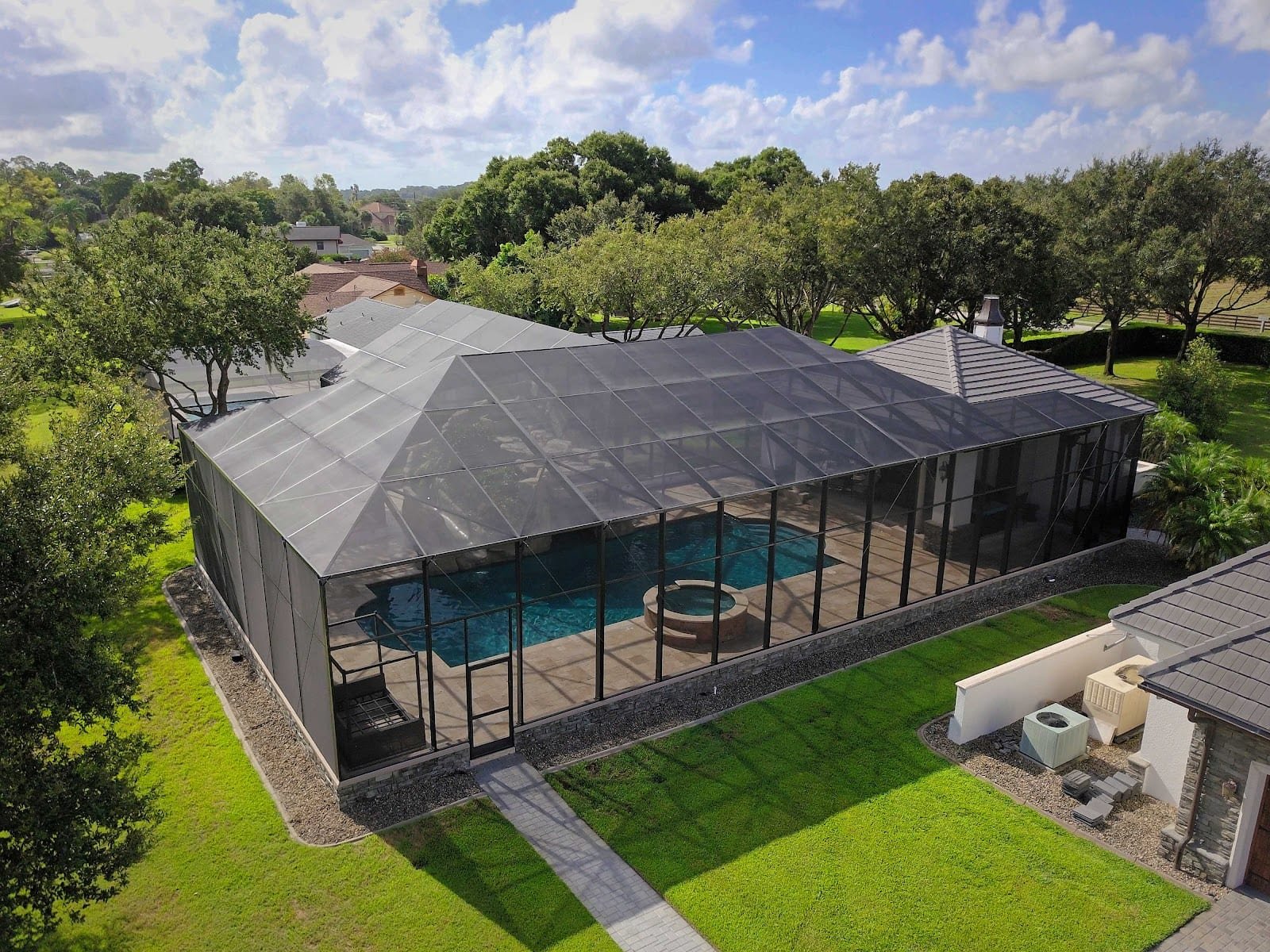
Step 1: Initial Assessment & Design. Your contractor surveys the site, measures the pool deck, and verifies which wind-load zone your address falls under before drawing anything. This determines the frame gauge, screen type, and overall feasibility of your preferred layout.
Step 2: Permit Application Submission. The contractor submits structural calculations, site plans, and material specifications to Manatee County. This phase alone typically takes two to four weeks depending on the department's current review volume—plan around it, don't fight it.
Step 3: Permit Review & Approval. A building official reviews the submitted plans against setback rules, easement restrictions, and code compliance. The most common rejection reasons are setback violations, easement conflicts, and wind-load mismatches caught during Step 1 that weren't fully corrected.
Step 4: Foundation & Ground Prep. Excavation and, if required, concrete footing pour happen here. Level verification at this stage is critical—an uneven foundation creates alignment problems for every subsequent phase.
Step 5: Frame Assembly & Installation. The aluminum frame arrives and goes up piece by piece. Connections are bolted and sealed with marine-grade sealant designed to resist the same salt exposure that degrades unprotected metal.
Step 6: Screening & Hardware. Screen material—fiberglass, polyester, or no-see-um mesh depending on your spec—is stretched and stapled into the frame channels. Doors and hardware are installed and tested for operation.
Step 7: Final Inspection & Walkthrough. The building official conducts a final walkthrough, confirms compliance, and issues sign-off. This is what clears the project for use and protects your resale value down the line.
- Permitting delay is the longest single phase—start the process 3–6 weeks before your target installation date.
- Don't schedule follow-up work (like pool heater relocation or electrical) until the enclosure passes inspection; moving deadlines during construction compounds delays.
- Request a pre-inspection walkthrough with your contractor 1–2 days before the official inspection to catch minor issues early.
4. Entryway Screen Enclosure Bradenton: Design, Material, and Setback Rules
Before your contractor draws a single line, you need to know exactly where your property lines sit. Manatee County requires a minimum 5-foot setback from side and rear property lines for pool enclosures, and enclosures are prohibited from encroaching into recorded easements—utility, drainage, or HOA access corridors that may run through your backyard even if there's no visible marker.
Finding your property lines and easements doesn't require hiring a surveyor from scratch in most cases—Manatee County's online parcel and plat records show recorded easements clearly, and your original property survey (usually filed with your closing documents) will show the rest. The mistake homeowners make repeatedly is designing the full enclosure footprint first, then discovering during permitting that a corner clips the setback line. That triggers a redesign, a resubmission, and another two to four weeks added to the timeline—entirely avoidable with a ten-minute records check upfront.
Once the footprint is confirmed, entryway design becomes the next decision point for any entryway screen enclosure Bradenton project. Sliding glass doors offer a clean look and easy pool access, but Bradenton's humidity means the tracks need annual cleaning to keep them running smoothly—salt and sand build up faster here than in drier climates. Single-swing aluminum doors and double-hinged doors require less mechanical maintenance and tend to hold up better against the coastal air over time, though they demand slightly more clearance space in the design. Entry placement also matters structurally: where you put the door affects how wind load distributes across the frame, which is one more reason the entryway isn't a cosmetic afterthought—it's part of the engineering.
- Pull your Manatee County parcel map and plat online before your contractor's initial site visit—this 10-minute step saves weeks of redesign.
- If your property has an easement (utility, drainage, or HOA access), it's marked on your plat; enclosures cannot be built in easement zones.
- Sliding glass doors are popular but require annual track cleaning in Bradenton's humid climate to operate smoothly; aluminum swing doors need less maintenance.
5. Cost Breakdown: What You'll Pay for an Aluminum Pool Enclosure in Bradenton
Cost conversations get murky fast because contractors bundle line items differently. Breaking the total into its actual components—materials, labor, and permitting—gives you a much clearer picture of where your money is going and where corners might be getting cut.
Material costs scale with your finish choice: standard fiberglass screen on a basic aluminum frame sits at the low end, while PVDF-coated aluminum with polyester screen and a dedicated entry door pushes toward the premium end. Labor covers permitting legwork, site prep, frame installation, screening, and the final inspection walkthrough. Size and complexity—linear footage, number of angles in the frame, additional entry doors, and any electrical work like pool heater relocation—all add to the total. Most reputable contractors also include a 5 to 10-year structural warranty, though it's worth clarifying exactly what's covered versus what falls under routine maintenance you're responsible for.
| Enclosure Type & Features | Cost Range (Bradenton) | Timeline | Best For |
|---|---|---|---|
| Standard Aluminum + Fiberglass Screen | $8,000–$12,000 | 4–8 weeks (including permits) | Basic protection, moderate wind exposure |
| Aluminum + Polyester Screen (Upgraded) | $12,000–$16,000 | 5–9 weeks | High-wind zones, longer durability |
| Premium PVDF Coating + Polyester + Entry Door | $16,000–$20,000 | 6–10 weeks | Direct coastal, maximum lifespan, full amenities |
| Custom/Oversized or Multiple Entry Points | $20,000+ | 8–12 weeks | Large pools, complex designs, premium finishes |
There are hidden costs worth budgeting for beyond the headline number: permitting fees scale with project valuation, engineered stamped drawings may be billed separately, and labor pricing tends to climb 10 to 15% during Bradenton's peak season (May through October) when tourist-area demand strains contractor availability. None of these are dealbreakers, but they're the kind of detail that turns a surprise into a planned expense if you ask about them early. Neglecting ongoing care after installation also has a cost—understanding ongoing maintenance and repair costs for comparable Gulf Coast climates helps you budget realistically for the enclosure's full lifespan, not just the installation invoice.
- Get 2–3 detailed quotes breaking down labor, materials, and permitting separately—vague totals hide what you're actually paying for.
- Bradenton summer (May–October) has peak demand; budget 10–15% higher labor costs if scheduling during tourist season.
- Most reputable contractors include a maintenance guide and 1–2 year inspection clause in the contract—ask about this upfront.
6. Screen Material Selection: Fiberglass vs. Polyester vs. No-See-Um Mesh for Bradenton
Screen material gets less attention than the frame, but it's just as consequential for how long your enclosure holds up. Standard fiberglass is the most common choice because it's affordable and widely available, but salt spray accelerates its breakdown—expect five to seven years of good performance in Bradenton before discoloration and brittleness show up.
Polyester screen is woven with two to three times the tensile strength of fiberglass, which is exactly why it's the material most often specified to meet the 140–160+ mph wind ratings required in Bradenton's higher-wind zones. It also simply lasts longer in salt air—typically 10 to 12 years compared to fiberglass's 5 to 7. No-see-um mesh uses an ultra-fine weave that blocks the microscopic sand flies and gnats common near open water, which makes it popular for beachfront properties specifically. It comes at a premium, and it's more fragile against salt-air wear than polyester, so it demands more consistent care.
A hybrid approach—polyester on the main exposed sides for wind and durability, no-see-um mesh around entry points and high-traffic seating areas for insect control—gives many Bradenton homeowners the best of both without paying the full no-see-um premium across the entire enclosure.
| Screen Type | Wind Resistance | Durability in Salt Air | Insect Protection | Maintenance | Cost vs. Fiberglass |
|---|---|---|---|---|---|
| Standard Fiberglass | Moderate (100–120 mph) | Fair—corrodes in 5–7 years | Good (no-see-um insects pass through) | Annual washing, occasional repairs | Baseline (0%) |
| Polyester (High-Strength) | Excellent (140–160+ mph) | Very Good—lasts 10–12 years | Good (same as fiberglass) | Minimal—very durable | +15–25% |
| No-See-Um Mesh | Moderate (similar to fiberglass) | Fair—more fragile, salt-air wear | Excellent (blocks tiny insects) | Higher—delicate material | +20–30% |
| Combination (Polyester + No-See-Um Hybrid) | Excellent | Very Good | Excellent | Low–Moderate | +30–40% |
- Polyester is the standard recommendation for Bradenton; it's worth the 15–25% upcharge because it outlasts fiberglass in salt spray.
- No-see-um is popular for beachfront homes; if you're 2+ miles inland, standard fiberglass or polyester is sufficient.
- Some HOAs prohibit certain screen colors (gray is most common); confirm before ordering to avoid delays.
7. Maintenance and Longevity: Keeping Your Aluminum Enclosure Coastal-Ready Year-Round
Even the best material spec loses its advantage without basic upkeep. An annual maintenance checklist for Bradenton enclosures should cover four things: visual sealant inspection at every joint, a scan of the screen for tears or sagging, a check of hardware tightness on doors and hinges, and general frame cleanliness.
Salt spray cleaning matters more here than in most parts of the country. Gentle pressure washing—under 1,500 psi—with fresh water rinses away salt deposits before they have a chance to accelerate corrosion at the joints. Sealant is the other piece people overlook: silicone and polyurethane caulk typically degrade within 5 to 10 years, and once it starts cracking or pulling away from the frame, it becomes the entry point for water intrusion, which is the actual gateway to rust underneath the finish.
Screen damage falls into two categories. Small tears can be patched without replacing the whole panel. Widespread discoloration, brittleness, or sagging across multiple sections signals it's time for a full-screen swap rather than piecemeal repairs—patching a screen that's failing everywhere just delays the inevitable while looking uneven. If you're managing an older Bradenton property with a wood-framed enclosure, be aware that wood requires a different maintenance approach entirely; pressure washing that's safe for aluminum can damage wood framing, and many owners use a major repair as the trigger to upgrade to aluminum instead of restoring wood.
- Schedule pressure washing in spring (pre-hurricane season) and fall (after summer storms) to remove salt and debris.
- If caulk is cracking or pulling away from the frame, schedule sealant refresh immediately—water intrusion is the gateway to rust.
- Document maintenance with photos and dates; a well-maintained enclosure adds 3–5 years to lifespan and strengthens resale value.
If your existing enclosure is already showing corrosion, it's worth reviewing this guide to rust diagnosis and repair for existing enclosures before deciding between a patch job and a full rebuild.
What This Means for Bradenton Homeowners, HOA Members, and Property Managers
- Specifying PVDF-coated aluminum and upgraded polyester screens upfront costs 20–30% more but extends enclosure life by 10+ years and eliminates mid-life corrosion repairs—a net savings of $5,000–$10,000 over the enclosure's lifespan.
- Permitting is the critical path; failing to verify wind-load codes and property setbacks before design guarantees 2–6 week delays and potential redesign costs. Early verification with the building department pays for itself.
- Maintenance discipline (annual cleaning, sealant inspection, screen repairs) is non-optional in Bradenton's salt-air climate—skipping it reduces enclosure lifespan by 30–50% and accelerates corrosion.
- Screen material choice (fiberglass vs. polyester vs. no-see-um) depends on your location (direct coastal vs. inland), budget, and insect tolerance; polyester is the Bradenton standard for maximum durability.
- Cost is transparent when you break down labor, materials, and permitting separately across 2–3 quotes; lowest price often signals cut corners on PVDF coating or engineered design, which fail faster in salt air.
Keep Learning
- Pool Cage Rust Repair in Lakewood Ranch: A Complete Diagnosis & Fix Guide — Understand what rust stains mean, how to diagnose corrosion severity, and when repair vs. replacement makes financial sense. Directly relevant if your existing enclosure is showing age.
- Pool Screen Repair Cost in North Port, FL: 2026 Price Guide — Breakdown of screen repair costs, common damage patterns, and whether patching or full-screen replacement is more economical in Sarasota-area (similar climate to Bradenton).
Frequently Asked Questions
Do I really need PVDF coating, or is anodized aluminum good enough for my Bradenton property?
It depends on your exact exposure. Homes directly on the water or within a mile of Tampa Bay should specify PVDF for the 15–20+ year lifespan. Properties with moderate coastal exposure, further from open water, often do fine with architectural-grade anodizing at a lower cost.
How long does the full permitting and installation process take in Manatee County?
Plan for roughly 4 to 10 weeks total depending on your enclosure's complexity, with permitting alone typically taking 2 to 4 weeks. Standard fiberglass-screen designs move faster than premium PVDF and custom entry-door projects, which can stretch to 8–12 weeks.
What happens if my enclosure design doesn't meet the wind-load requirement for my zone?
The permit gets rejected during the building official's review, forcing a redesign and resubmission—adding weeks to your timeline. This is why verifying your specific wind-load zone before design, not after submission, is so important.
Can I install my enclosure closer than 5 feet to my property line if my lot is small?
No—Manatee County's 5-foot minimum setback from side and rear property lines applies regardless of lot size, and enclosures cannot encroach into recorded easements. A smaller lot may limit your enclosure footprint rather than allowing an exception to setback rules.
Is polyester screen worth the extra cost over standard fiberglass?
For most Bradenton properties, yes. Polyester meets the higher wind-load ratings required in coastal zones and lasts roughly twice as long as fiberglass in salt air, which usually offsets the 15–25% price premium over the enclosure's lifetime.