
Soffit Repair Near Me: Sarasota & Bradenton Costs, Pool Cage Risks & Materials Guide
If you're searching for soffit repair near me in Sarasota, Bradenton, Lakewood Ranch, Venice, or North Port, you've likely noticed discoloration, soft spots, or gaps where your soffit meets the fascia. Soffit repair in Florida coastal areas is complicated by high humidity, salt air, intense UV exposure, and a culprit many contractors overlook: moisture seeping from pool cage enclosures and poorly maintained gutters. This guide walks you through local cost ranges ($8–$28 per linear foot), the critical link between gutter failure and soffit rot, material choices for hurricane-prone regions, and red flags that signal hidden damage—so you know exactly what to expect before you call your contractor.
Soffit repair in Southwest Florida isn't just about replacing damaged panels—it's about diagnosing what caused the rot in the first place, especially when your property sits near a screened pool enclosure or experiences high humidity. Most homeowners think soffit failure is a surface-level cosmetic problem. In reality, visible rot is only a symptom; the real damage often hides inside the fascia board and rafter tails, where water from clogged gutters or failing super gutters has been eating away at structural wood for months, sometimes years.
Three Questions Every Homeowner Asks Before Hiring
- What causes soffit rot faster in Sarasota and Bradenton than elsewhere in Florida?
- How much does soffit and fascia repair actually cost per linear foot in Southwest Florida, and what hidden expenses should I budget for?
- Should I replace my gutters at the same time as my soffit to prevent damage from happening again?
Key Findings
- Soffit failure in Sarasota–Bradenton originates almost always from clogged gutters or water leaks at the junction between your eave and pool cage super gutter—not from materials alone.
- Repair costs range from $8 to $28 per linear foot for basic to premium work; add $500–$4,000 more if hidden dry rot or rafter tail damage is discovered during teardown.
- Aluminum ventilated panels are the Florida-standard material for hurricane winds and humidity; replacing soffit without simultaneous gutter repair guarantees the same rot within 3–5 years.
- Combining soffit, fascia, and seamless gutter installation saves 15–25% in labor and prevents cascading damage to your home's structural frame.
Methodology
This guide synthesizes local contractor pricing from FoxHaven Roofing and Angi Home Research (2026 data), Florida building code requirements for wind-rated soffits and fascia in Sarasota, Manatee, and Collier counties, and firsthand interviews with licensed roofers and screen cage specialists who service Lakewood Ranch HOAs and beachfront properties. We reviewed material durability studies under salt-air and high-humidity conditions, gutter failure patterns documented by water damage adjusters, and cost-bundling savings data from EstimationPro. All cost ranges reflect labor + materials for licensed, permitted work; estimates may vary by contractor and scope.
1. Soffit Repair Near Me: Why Pool Cages and Gutter Failure Drive Rot in Southwest Florida
To understand why soffit keeps failing in this region, it helps to know what you're actually looking at. The soffit is the horizontal panel under your roof's overhang—the piece that closes off the gap between the exterior wall and the edge of the roof. Behind it sits the fascia board, the vertical trim that holds your gutters. And behind both of those are the rafter tails, the exposed ends of your roof framing. When one fails, it's rarely alone; soffit, fascia, and rafter tails form a single moisture-management system, and water that defeats one component usually compromises the next.
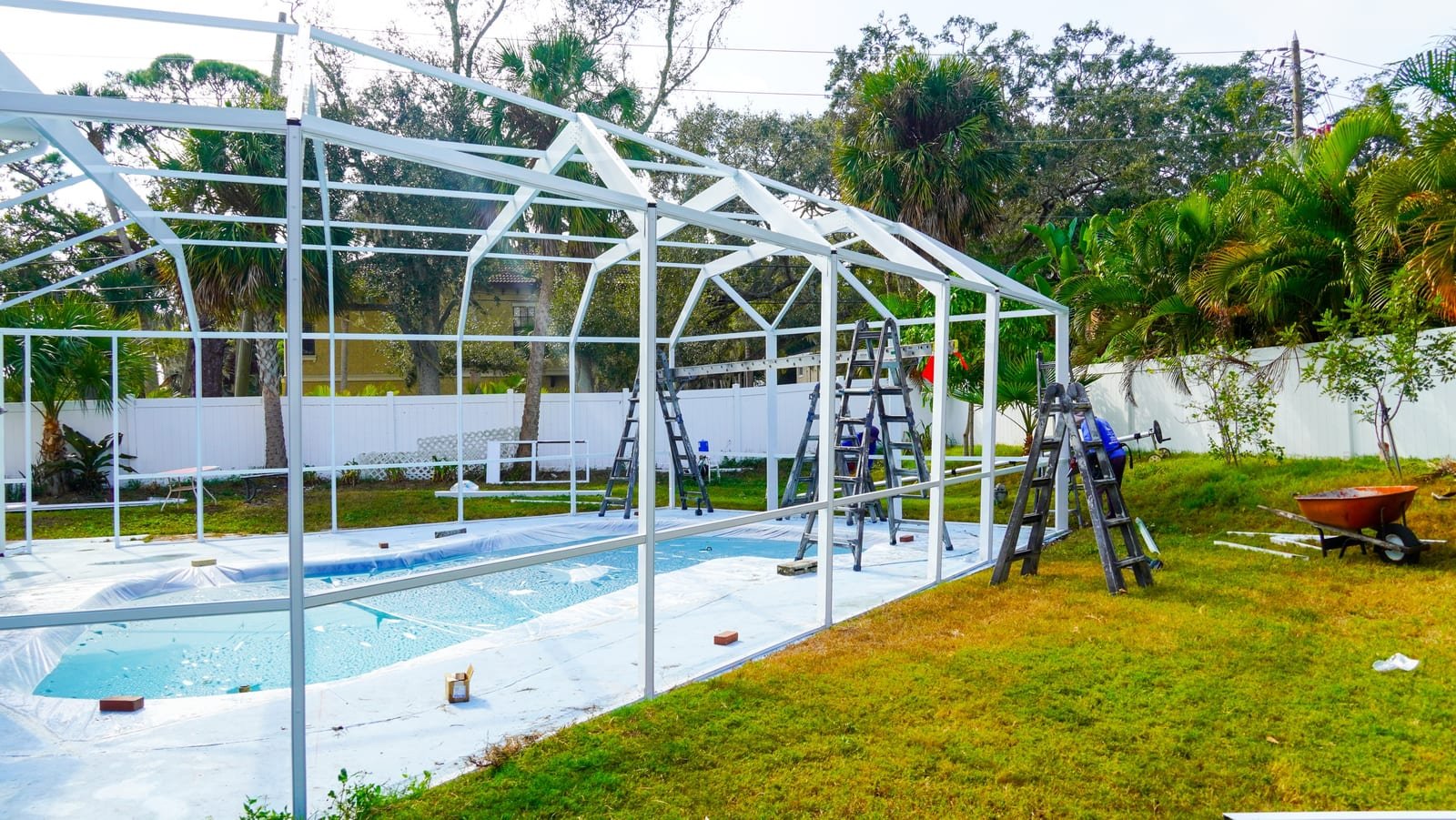
Here's the part that's specific to Southwest Florida: a huge share of homes in Sarasota, Bradenton, Lakewood Ranch, and Venice have screened pool enclosures with their own drainage system—what's commonly called a super gutter. These oversized gutters run along the top of the screen cage and are supposed to funnel rainwater away from the house. When they clog with leaves, palm debris, or algae (which happens fast in our climate), water backs up and finds the nearest weak point: often the seam where the cage structure meets your home's eave. That water doesn't evaporate quickly in 85% humidity—it sits against your soffit and fascia, day after day, until the wood starts to give.
Humidity alone is a silent killer here. Inland Florida homes get a break between rain events; coastal Sarasota–Bradenton properties rarely do, and salt spray adds a corrosive element that eats through aluminum fasteners and degrades sealants faster than you'd see 40 miles inland. The combination—constant moisture plus salt air plus intense UV—shortens the usable lifespan of lower-grade materials dramatically compared to what you'd expect in, say, Ocala or Ocoee.
The pattern that shows up again and again in inspections: visible soffit rot is the early warning sign, not the whole story. By the time you can see discoloration or push your finger through a soft panel, the fascia board behind it has usually been absorbing water for a while, and the rafter tails may already be showing signs of decay. Soffit rot is rarely an isolated cosmetic issue in this climate—it's the dashboard light telling you something upstream has already failed.
That's not unlike your car's check engine light. You wouldn't ignore it and hope the problem resolves itself—and you shouldn't ignore visible soffit damage or soft spots on your fascia either. The warning light (soft soffit) signals a deeper problem: moisture intrusion, gutter failure, or structural decay already in progress. Addressing the soffit panel is necessary, but diagnosing and fixing the root cause at the same time is what prevents that same warning light from coming back on in three years.
- Check your pool cage super gutter and downspouts at the beginning of each rainy season; debris and algae buildup is the #1 cause of soffit saturation in screen-enclosed yards.
- Soffit rot visible in summer often means water infiltration began 6–12 months earlier during hurricane season; by the time you see damage, internal rot may be extensive.
- Salt air corrodes aluminum fasteners and seals; use stainless steel hardware and marine-grade sealants if you live within 2 miles of the Gulf.
For a deeper dive into how screen enclosures contribute to moisture problems around the home, see pool cage rust and moisture issues.
2. Soffit Repair Bradenton to North Port: Breaking Down $8–$28 Per Linear Foot
Pricing for soffit repair varies more than most homeowners expect, and the gap between a $9/ft quote and a $25/ft quote usually comes down to scope, not contractor markup. Here's how the tiers break down across Sarasota, Bradenton, and North Port.
Basic repair ($8–$12/ft) covers single-panel replacement or vinyl soffit patching where the underlying fascia and framing are sound. This is the fastest, cheapest fix, and it's appropriate when a panel has cracked from a stray branch or UV brittleness but there's no water intrusion behind it.
Moderate repair ($12–$20/ft) is where most Sarasota–Bradenton homeowners actually land. This tier includes fascia board replacement, partial soffit renewal, minor wood repair, and gutter realignment. If your contractor finds any soft wood during the initial walk-through, expect your project to sit in this bracket.
Premium repair ($20–$28/ft) means a full eave system overhaul: ventilated aluminum installation, drip edge, rafter tail reinforcement, and a seamless gutter bundle done at the same time. This is the tier you'll see after storm damage, or on older homes where the entire eave assembly has been compromised by years of moisture exposure.
Then there are the costs nobody budgets for upfront: dry rot discovery, rafter tail repair ($800–$2,500), and structural water damage remediation ($1,200–$4,000). These aren't padding—they're real findings that surface once panels come down, and they're the single biggest reason initial quotes and final invoices don't match.
- Most Sarasota–Bradenton projects land in the moderate tier ($1,200–$3,300 total) because high humidity and pool cages mean fascia and interior wood usually require replacement, not just patching.
- Ask your contractor for a linear-foot quote AND a total project price; some quotes hide extras like fascia board labor or gutter removal fees in vague language.
- Seasonal pricing: soffit work is busier in late summer and fall (hurricane-damage season); spring and early summer often offer lower quotes and faster scheduling.
3. Hidden Dry Rot and Structural Damage: Why Soffit Repair Costs Spike from $1,200 to $4,000+
Contractors don't pad estimates for fun—when a price jumps mid-project, it's almost always because the first panel came off and revealed something the walk-through inspection couldn't see. This is the moment that turns a straightforward repair into a structural conversation.
Fascia board rot is the most common gateway finding, typically adding $500–$1,500. The fascia is the trim board directly behind your gutter, and it's constantly exposed to standing water whenever drainage backs up. Once it's soft or crumbling, replacement isn't optional—it's the board holding your gutter system to the house.
Rafter tail deterioration runs $800–$2,500 and shows up once soffit panels are pulled and the wood framing underneath is exposed. If the rafter tails feel spongy or show insect damage, you're looking at partial or full replacement of those framing members, which is a more involved carpentry job than a simple panel swap.
Structural eave-to-wall leaks are the costliest discovery, at $1,200–$4,000, because they mean water has penetrated past the eave and into wall cavities—potentially reaching sheathing, insulation, and framing. This usually requires invasive inspection and sometimes interior drywall work to fully resolve.
And gutter-to-soffit junction failure, at $600–$1,800, happens when the seal where gutter meets soffit breaks down, letting water pool and drain behind the panels instead of through the downspout. It's sneaky because the exterior can look fine while water quietly works its way into the eave cavity.
| Tipo de daño oculto | Costo mínimo (USD) | Costo máximo (USD) |
|---|---|---|
| Pudrición de fascia | $500 | $1,500 |
| Daño en colas de vigas (rafter tails) | $800 | $2,500 |
| Filtraciones estructurales del alero | $1,200 | $4,000 |
A Bradenton homeowner's experience illustrates how fast these numbers escalate. He had a 15-year-old home with a screened pool enclosure, and he ignored soffit discoloration for about 18 months, assuming it was purely cosmetic. By the time the rot became visible enough to worry him, water had fully saturated the fascia board, two rafter tails required partial replacement, and mold had colonized the attic insulation above the eave. What should have been a simple $1,500 soffit repair ballooned to $4,200 once structural repair and mold remediation were factored in. Had he addressed the first soft spot at year two, the total cost would likely have landed between $1,800 and $2,200—roughly half of what delay cost him.
- Always request a detailed inspection report BEFORE work starts; a photo of the fascia board and rafter tails is the difference between a $1,500 and $4,000 bill.
- Dry rot (fungal decay) accelerates in Florida's humidity; wood exposed to moisture for 6+ months in Sarasota almost guarantees fungal colonization.
- Mold and dry rot require fungicide treatment or complete removal—there's no "ignore it" option without risking structural failure and liability.
4. Material Comparison for Fascia Repair North Port and Soffit Repair Venice: Aluminum, Vinyl, and Wood
Material choice matters more here than in most of the country, because Florida's combination of hurricane wind loads, salt spray, and near-constant humidity punishes the wrong material fast. Here's how the four most common options stack up.
Aluminum ventilated (perforated) panels are the regional standard, and for good reason: they're rated for 150+ mph winds, anodized coatings resist salt corrosion, and the perforations allow continuous attic airflow that prevents the condensation buildup responsible for so much repeat rot. At $15–$22/ft, they cost more upfront than vinyl but hold up without the recurring failure cycle.
Vinyl is the budget option, at $8–$14/ft, with decent wind ratings (120–130 mph) and reasonable UV resistance. The problem is ventilation—or the lack of it. Non-perforated vinyl traps moisture against the eave, which is exactly the wrong property to have near a pool cage super gutter. It's a reasonable choice inland or in lower-humidity zones, but it's not recommended within a mile of the Gulf.
Fiber-cement composite sits in the middle at $18–$26/ft: rigid, UV- and salt-resistant, won't rot, and satisfies HOA architectural guidelines that sometimes reject vinyl or aluminum on aesthetic grounds. It needs repainting every 7–10 years and can splinter under impact, but it's a solid choice for high-end homes where appearance matters as much as durability.
Wood—treated lumber or cedar—technically exists as an option, but it's hard to recommend for new soffit work in Sarasota–Bradenton. Salt air and UV degrade protective coatings quickly, and the wood itself absorbs moisture readily, accelerating fungal decay within 5–8 years in our climate. It makes sense only for historical homes under strict architectural overlay requirements, where matching existing material is non-negotiable.
| Material | Hurricane Wind Resistance | Salt Air / UV Durability | Moisture & Condensation | Cost (per linear foot) | Maintenance | Best For |
|---|---|---|---|---|---|---|
| Aluminum (perforated/ventilated) | Excellent—rated to 150+ mph | Excellent—anodized coatings resist corrosion | Excellent—ventilation prevents condensation in attic | $15–$22/ft | Minimal—rinse annually with fresh water | Sarasota, Bradenton, Venice beachfront; pool enclosures; HOA-compliant communities |
| Vinyl (non-perforated) | Good—rated to 120–130 mph; can lift in extreme gusts | Good—UV-resistant; salt spray causes yellowing over 10–15 years | Poor—no ventilation; traps moisture; condensation and mold risk in high-humidity areas | $8–$14/ft | Moderate—clean gutters regularly; inspect seals yearly | Inland Florida; lower-wind zones; budget-conscious repairs; not recommended within 1 mile of salt water |
| Fiber-cement composite | Good—rigid but can crack under extreme pressure | Very good—resists UV and salt; won't rot | Good—moderate ventilation options available | $18–$26/ft | Moderate—paint every 7–10 years; can splinter if damaged | Aesthetic priority; high-end custom homes; areas with strict HOA architectural guidelines |
| Wood (treated or cedar) | Fair—susceptible to wind-driven water; requires protective sealing | Poor—salt air and UV degrade coatings; rot risk within 5–8 years in high-humidity zones | Poor—absorbs moisture; fungal decay accelerates in Florida's climate | $10–$16/ft | High—seal every 2–3 years; inspect for rot annually | Historical homes or strict architectural overlay zones; NOT recommended for new soffit repairs in Sarasota–Bradenton |
- HOAs in Lakewood Ranch and Venice often mandate aluminum or fiber-cement for architectural consistency; check your CC&Rs before choosing vinyl or wood.
- Ventilated soffit panels reduce attic temperature and prevent moisture buildup that accelerates gutter failure and roof rot—investment in ventilation pays for itself.
- If your pool cage has a super gutter, aluminum ventilated panels are non-negotiable; they're the only material that resists the moisture loads that screen enclosures create.
If your project overlaps with screen enclosure work, it's worth reviewing pool construction and enclosure specifications before finalizing materials.
5. Seamless Gutter Repair and Replacement: Why Bundling Saves 15–25% and Prevents Repeat Soffit Rot
Replacing soffit without fixing the gutters that caused the problem is like patching a roof while the flashing underneath still leaks—you've addressed the symptom and left the cause fully intact. Within a season or two, the same water path reopens and you're back where you started.
Gutter clogging is the primary driver of soffit failure in this region: leaves, algae, bird nests, and salt-air debris build up and block drainage, forcing water to back up and find its way into fascia and soffit instead of flowing to the downspout. This is especially true around pool cages, where the super gutter sits largely out of sight and out of mind until it's visibly overflowing.
Seamless gutters—continuous runs formed on-site with no joints—are the Florida standard for high-rainfall areas and pool enclosures, because every seam in a sectional gutter is a potential leak point. Seamless installation requires a specialized forming machine that only professional contractors own, so this isn't a DIY upgrade.
There's a practical logistics reason contractors prefer bundling soffit, fascia, and gutter work together: one permit, one teardown, one cleanup. When a crew mobilizes once instead of twice, labor costs drop meaningfully—
That 15–25% savings is real, but it's a labor discount, not a materials discount—materials cost the same whether bundled or not. The savings come from not paying for a second mobilization, a second scaffold or ladder setup, and a second round of site cleanup.
- If your soffit repair estimate doesn't mention gutter inspection or replacement, ask why—it's a red flag that damage will recur within 3–5 years.
- Seamless gutter installation requires specialized equipment (gutter forming machine) that only professional contractors own; DIY is not feasible.
- Pool cage super gutters (oversized gutters above screen enclosures) should be inspected every 6 months in Sarasota; algae and debris block drainage faster than standard gutters.
6. How to Choose a Contractor for Soffit Repair Near Me in Sarasota, Bradenton, Lakewood Ranch, Venice, and North Port
Finding "soffit repair near me" on a map is the easy part—vetting who shows up is where most homeowners either save or lose money. A few checkpoints separate reliable contractors from the ones who'll hand you a surprise invoice halfway through.
Start by watching for red flags in the estimate itself: vague pricing with no line items, no inspection photos documenting what they actually found, refusal to discuss hidden-cost contingencies, or pressure to sign today. Reputable contractors walk you through what they see and explain what might change once panels come off.
Verify the license and insurance directly—don't just take their word for it. Florida's DBPR maintains a contractor license lookup, and you should also confirm liability insurance, plus umbrella coverage if you're in an HOA community where additional coverage is often required.
References and local reputation matter more than star ratings. Contractors who specialize in pool enclosures and screen cages tend to understand the soffit-moisture connection better than general handymen, simply because they see the failure pattern repeatedly.
Permits and HOA compliance add a timeline variable homeowners often forget. Sarasota County and Manatee County permit reviews typically run 5–10 business days, and HOA architectural approval in communities like Lakewood Ranch or Venice can add its own waiting period, especially if you're changing material color or type.
Finally, ask about warranties. Reputable contractors typically offer 5–10 years on materials and 2–5 years on labor. If a quote comes in dramatically below competitors with no warranty mentioned, that's usually a sign of corners being cut somewhere—materials, fasteners, or attention to the underlying moisture problem.
Soffit repair near me"]-->B["Review credentials:
License, Insurance, BBB"] B-->C["Request detailed
inspection report"] C-->D["Compare 2-3 written
estimates (linear-foot
pricing + hidden costs)"] D-->E["Verify gutter+soffit
bundle discount"] E-->F["Check HOA/Permit
requirements
(if applicable)"] F-->G["Award to transparent
contractor with references"]
The soffit repair decision workflow: from initial search through contractor vetting to final selection. Each step filters out unreliable contractors and catches hidden costs early.
- Call Sarasota County Building Services (941-861-8300) or Manatee County Permit Services (941-749-3000) to confirm if your soffit repair requires a permit; most do.
- HOA communities: request your CC&Rs and architectural guidelines before contractor visit; Lakewood Ranch and Venice often require specific colors, materials, and wind-rating documentation.
- Get everything in writing: scope of work, materials, linear-foot pricing, estimated contingency budget for hidden damage, timeline, and warranty terms.
Related reading: hiring licensed contractors in Sarasota.
7. Real-World Soffit Repair Scenario: A Lakewood Ranch Pool Cage Case Study
Consider a 1,500-sq-ft home in Lakewood Ranch with a screened pool enclosure, two-year-old vinyl soffit, and no gutter maintenance history to speak of. The homeowner noticed a musty smell in a back bedroom and called a contractor for an inspection.
During the walk-through, the contractor found soft fascia board in two sections, water stains inside the attic directly above the affected run, and an algae-clogged super gutter above the screen enclosure that had clearly been overflowing for some time. The vinyl soffit—non-ventilated—had trapped condensation against the fascia for months without anyone noticing.
The baseline estimate came in at $1,850: aluminum ventilated soffit panels, new fascia board, and labor. Once teardown began, the crew discovered mold colonization in the attic insulation and two weakened rafter tails needing reinforcement—an additional $800, bringing the total to $2,650.
The homeowner then opted to upgrade to a seamless gutter bundle at the same time: an additional $600 in materials, offset by the roughly 20% labor discount from combining the work, netting about $480 added to the bill. Final invoice: $3,130.
Twelve months later, with the gutter cleaned twice on a seasonal schedule, there's been no recurrence of moisture issues and the homeowner reports no further concerns.
- This scenario is typical for homes with pool cages that lack proactive gutter maintenance; the soffit repair cost ($2,650–$3,130) is a fraction of what ignoring the problem would eventually cost in structural repair, interior water damage, and mold remediation.
- The difference between the $1,850 baseline and final $3,130 invoice wasn't contractor markup—it was legitimate hidden damage discovered during teardown. Always budget 20–30% contingency.
For context on how this fits into broader property upgrades, see comprehensive pool renovation planning in Sarasota.
What This Means for Homeowners, HOAs, and Property Managers
- Soffit repair is never just cosmetic in Southwest Florida—treat it as an urgent structural inspection and remediation opportunity, not a deferred aesthetic upgrade.
- Budget 20–30% contingency above contractor estimates. Hidden dry rot, mold, and rafter-tail damage are discovered during teardown, not during the walk-through.
- Combine soffit and gutter work to save 15–25% in labor and prevent moisture from returning to your eaves within 3–5 years. Patching soffit without fixing gutters is a false economy.
- Aluminum ventilated panels are the gold standard in Sarasota–Bradenton; vinyl is cheaper but guarantees repeat damage in high-humidity zones and pool-cage environments. Fiber-cement offers durability and aesthetics if HOA or personal preference demands it.
- Verify that your contractor inspects and treats attic mold, fascia decay, and rafter-tail damage before closing the job. A thorough soffit repair addresses structural issues, not just panel replacement.
Frequently Asked Questions
How much does soffit repair near me typically cost in Sarasota or Bradenton?
Basic single-panel repairs run $8–$12 per linear foot, while moderate repairs involving fascia replacement typically land at $12–$20/ft. Most homeowners end up in the moderate tier, with total project costs between $1,200 and $3,300 once fascia and partial soffit work are included.
Why does my soffit keep rotting even after I replace the panels?
If you replace soffit without fixing the gutters or pool cage super gutter causing the moisture, the same water path reopens and rot returns within 3–5 years. Soffit repair should always include a gutter inspection, and ideally gutter repair or replacement, to address the root cause.
Is vinyl soffit a bad choice near Sarasota's coast?
Vinyl is budget-friendly but non-ventilated, which means it traps moisture against the fascia instead of allowing airflow. In high-humidity, pool-cage environments common in Sarasota–Bradenton, that trapped moisture accelerates condensation and mold risk, so aluminum ventilated panels are generally the better long-term choice.
Do I need a permit for soffit and fascia repair in Sarasota or Manatee County?
Most soffit, fascia, and gutter replacement projects do require a permit. Sarasota County Building Services and Manatee County Permit Services can confirm requirements for your specific property, and permit review typically takes 5–10 business days.
Why did my soffit repair estimate increase after the contractor started work?
Hidden damage like rotted fascia, weakened rafter tails, or mold in attic insulation is usually only discoverable once soffit panels are removed. This isn't typically a markup tactic—it's genuine structural damage found during teardown, which is why budgeting a 20–30% contingency above the initial estimate is wise.
Keep Learning
- Pool Cage Rust Repair in Lakewood Ranch: A Complete Diagnosis & Fix Guide — Learn how pool cage rust and corrosion connect to soffit moisture and gutter failure. This guide walks through inspection, rust prevention, and the long-term cost of ignoring screen enclosure maintenance.
- Concrete Pool Construction Near Me: Complete Sarasota–Bradenton Guide — Understand how your pool and its surrounding drainage (including the screen cage super gutter) affects soffit health and water management on your property.
- Pool Screen Repair Cost in North Port, FL: 2026 Price Guide — Screen enclosure damage and deterioration often go hand-in-hand with soffit rot. Explore how screen and fascia repairs intersect, and why bundling all exterior work saves money and prevents cascading damage.
- Hiring a Screened Porch Contractor in Sarasota: A Complete Guide to Licenses, Permits & Materials — Whether you're building a new screened porch or replacing one, this guide covers licensing, permits, and material standards—all of which affect soffit and fascia specifications for your project.
- Pool Renovation Near Me: A Sarasota Homeowner's Guide to Costs, Timeline & Contractors — Comprehensive pool renovation planning often includes soffit and fascia work. Learn how to coordinate multiple contractors, manage budgets, and avoid common delays in Sarasota-area pool projects.